
The Backrooms grew up on YouTube. Hollywood is still adapting.
A teenager filming in his bedroom built one of the most influential new horror properties of the last decade. The studios noticed late. They are still figuring out what to do with what he made.
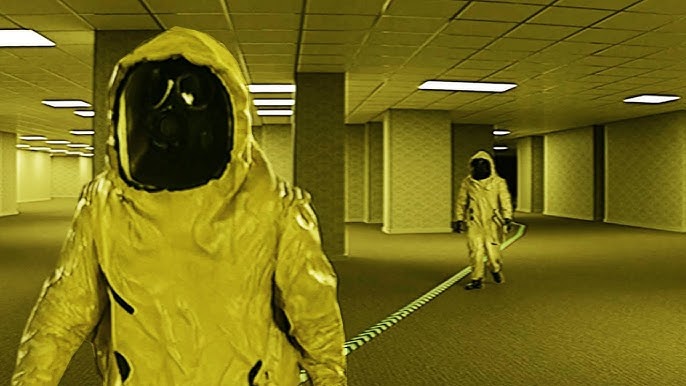
A24 announced in November 2022 that it had attached a director to its Backrooms feature. The director was a high school student in New York who had been making horror videos in his bedroom for ten months. Atomic Monster, James Wan's production company, was on as producer. A studio that had shown little public interest in YouTube horror was suddenly building a film around it.
The teenager was Kane Parsons. Online he goes by Kane Pixels. Before the deal he had uploaded a single eight-minute video called "The Backrooms (Found Footage)" in January 2022. By the time A24 called, the video had passed forty million views on YouTube (NYT, Nov 2022).
The 4chan post
The Backrooms started as a single 4chan reply on the 12th of May, 2019. The thread asked for unsettling images. A user posted a photo of a yellow-carpeted, fluorescent-lit, empty room, the kind of half-finished space a building site might have on its second floor. A different user added the lore underneath: about six hundred words describing a place you could fall into by "noclipping out of reality," with damp carpet, the constant hum of fluorescents, the smell of moist carpet, the warning that you should not be there.
The image and the lore went together in a way that was unusual for internet horror. Most creepypastas describe something. This was a place. You were already in it.
The mythology compounded across forums for two years. A wiki accumulated thousands of "levels". The wiki accumulated contradictions within months. The framing was unkillable.
The video that worked
Kane Pixels' first Backrooms video is eight minutes long. A teenager turns a corner in an office. The wall does not end. The footage runs on. Something is on the camera with him. The clip ends with the camera being dropped.
The footage looks bad on purpose, and the badness is the point. It is not high resolution. The colours are slightly wrong. The audio buzzes. Each technical choice argues, in concert with the others, that what is on screen is real. The viewer's eye is trained to associate clean footage with production. Imperfect footage carries the residual authority of consumer technology, the camcorders and phones that have shown people every important real event of their lives.
There is also what the video does not do. The Backrooms wiki had spent two years explaining the place. Kane explains nothing. The cameraman does not narrate. The thing chasing him is never named. The rules of the place are not stated. The horror is in the unanswered question. The wiki had over-answered. The video stops talking.
The third thing, and this is the one most studio horror gets wrong, is duration. Eight minutes is long enough to build tension and short enough to escape concept fatigue. Most internet horror runs on three-minute reveals. Kane commits to atmosphere for long enough that the room itself becomes the antagonist, without staying long enough for the room to become familiar.
A second video followed, then a third. By the eighth episode, the series had built a coherent fictional world around a corporation called Async Research investigating the Backrooms, a recurring entity called the Smiler, and a structured timeline. The horror was no longer about a single room. It was about an institutional pattern around the room.
What A24 saw
Variety reported the deal in November 2022. Kane was directing his first feature at 17. Atomic Monster, fresh off The Nun II, was producing. The audience the studio was buying access to was not a YouTube subscriber base, exactly. It was an internet generation raised on Five Nights at Freddy's, Slender, Marble Hornets, Local 58, and Mandela Catalogue, that already recognised analog horror as a native form rather than a budget compromise.
A24's bet is that found-footage horror at YouTube length is itself a genre with its own conventions, and that audiences will pay for a feature in it if the feature respects the form.
The form, precisely
Most attempts to define analog horror describe the texture and miss the rules. The rules are these:
The footage looks like found media, not produced media. The narrator is absent or unreliable. The threat is institutional, not personal. The lore is partial and contradictory. The viewer is not given a clean resolution. The world existed before the camera turned on and will continue after the camera stops.
A lot of studio horror in 2026 breaks these rules by default. The camera is clean. The third act resolves. There is a final-act monologue that lays out the mythology. The threat is, in the end, about one family or one cursed person. The lore is consistent because the writers' room made it so.
A film that calls itself a Backrooms adaptation while doing any of those things will, to the audience Kane built, register as a betrayal of form. The challenge facing Atomic Monster is whether they can hold the discipline for a 90-minute feature when their muscle memory is built for the violations.
The studio horror pipeline now has an upstream
The studio horror pipeline can no longer treat YouTube as a curiosity. Kane Pixels, Local 58, Mandela Catalogue, Vita Carnis, Gemini Home Entertainment, and the surrounding ecosystem now form a horror tradition with its own conventions. A new generation of horror creators is starting inside this ecosystem rather than at film school. The studios that build relationships with this ecosystem now are the ones most likely to work with its directors later.
The form is also teaching audiences to detect inauthenticity. Viewers raised on Kane Pixels can spot a Foley pickup or a steadicam shot from across the room. The threshold for "this feels real" has gone up. A studio production that drops a tracking dolly into a Backrooms-coded scene risks looking wrong to the audience the form was built for.
The film, if it ever comes out, will be tested against the videos. The videos are the standard. The studio horror pipeline now has an upstream it does not control.
Sources
3 cited- 01 A24, Atomic Monster team on 'Backrooms' film with Kane Parsons
Justin Kroll · Variety · Nov 10, 2022 · Article
- 02 Kane Pixels — The Backrooms (Found Footage)
Kane Pixels · YouTube · Jan 7, 2022 · Video
The original eight-minute video that started the franchise on YouTube.
- 03 How a teen turned a viral creepypasta into the next big horror franchise
Kalia Richardson · The New York Times · Nov 28, 2022 · Article
You might also like
-
 Culture
Toy Story 5 passed $879 million. Two Pixar originals barely returned their budgets. That is the ledger.
Elio finished at $154 million on a reported $150 million production budget. Hoppers reached $389 million on the same. Toy Story 5 opened to a franchise-record $312 million.
-
 Culture
Brand New Day's trailer crossed a billion views in four days. That is a signal worth reading.
Brand New Day's first trailer set a record for the format in March 2026. Read against Thunderbolts and Fantastic Four's 2025 numbers, it points at a specific thing that still works.
-
 Culture
Rick and Morty marketed Season 9 as 'No AI slop.' That is a position.
The Season 9 tagline names AI-generated animation as the thing the show is not. That is rarer than it looks in 2026, and the implications are interesting whether you read it as principle or as positioning.
-
 Culture
Gravity Falls ended in 2016. It has been continuing ever since.
The finale aired on Disney XD ten years ago. Since then Gravity Falls has produced three New York Times bestsellers, an international scavenger hunt, a decade of ciphers, and a franchise in continuation talks.